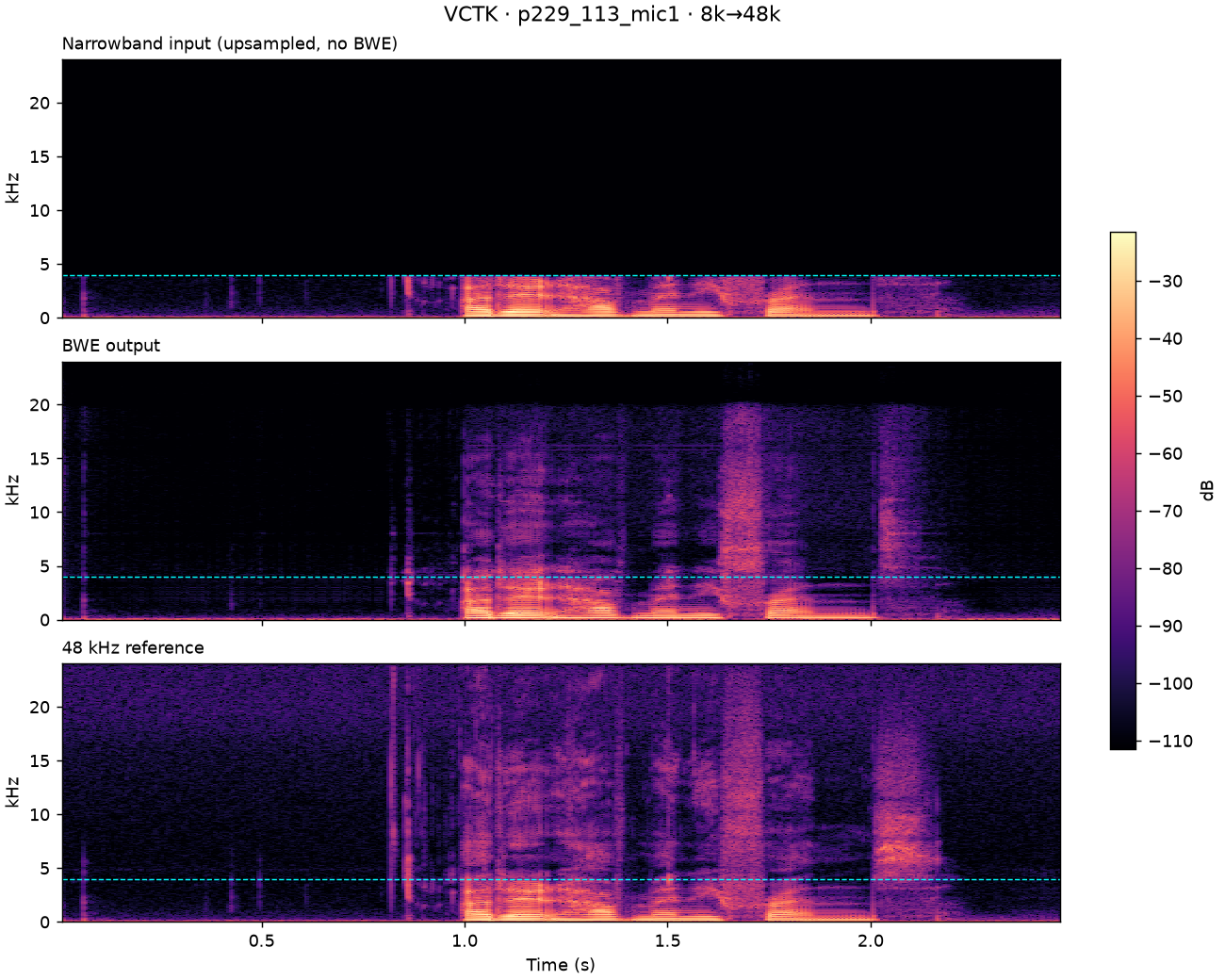
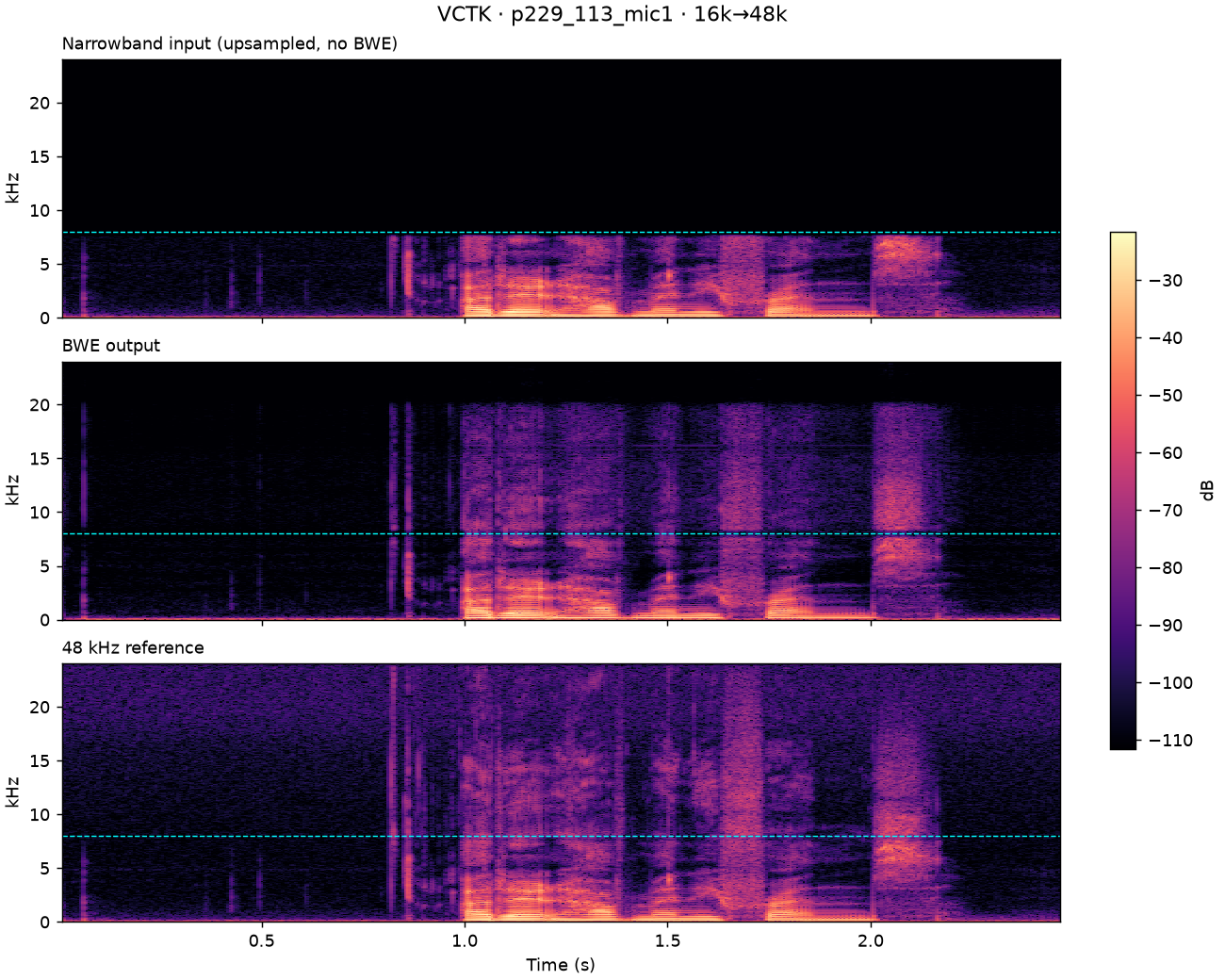
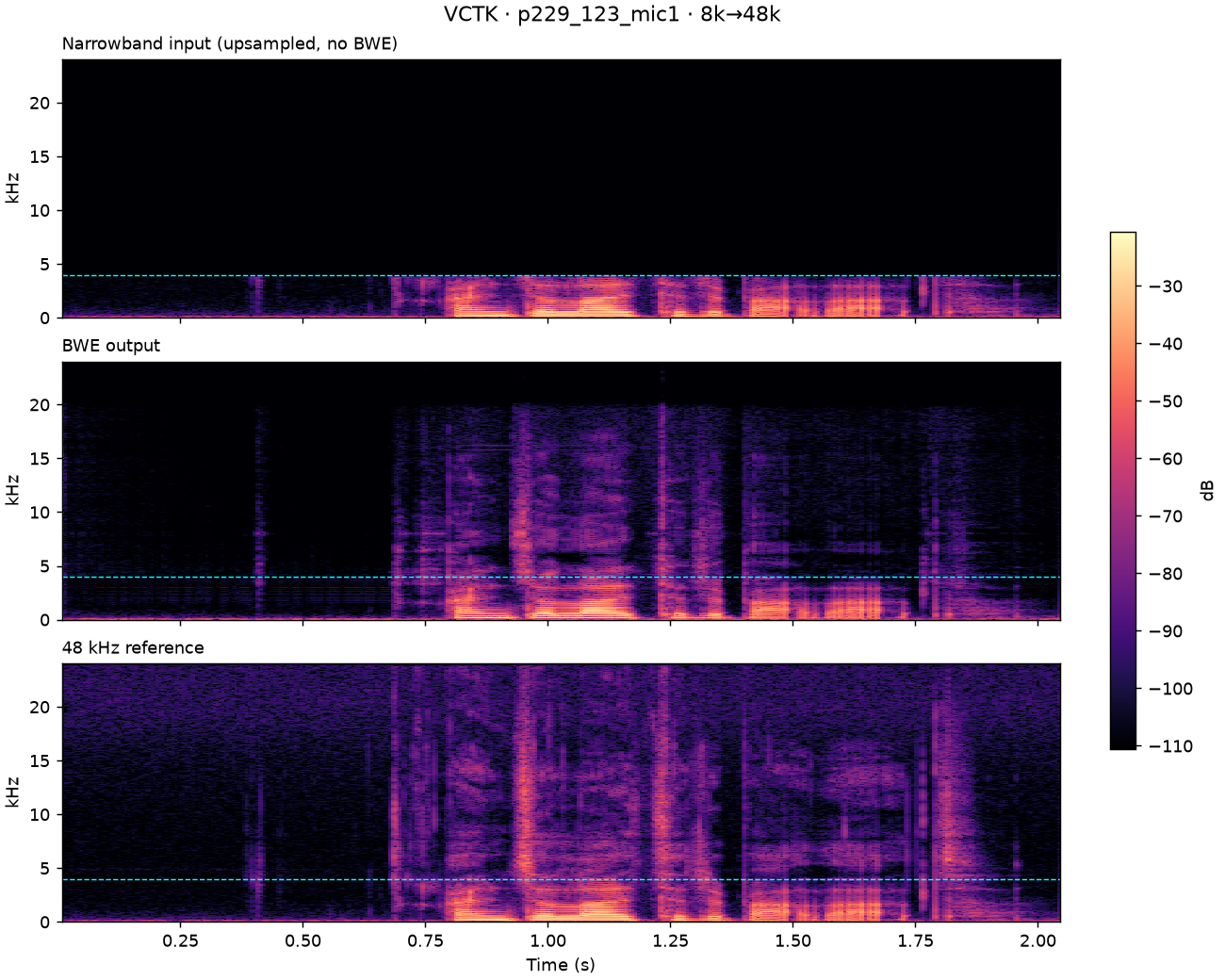
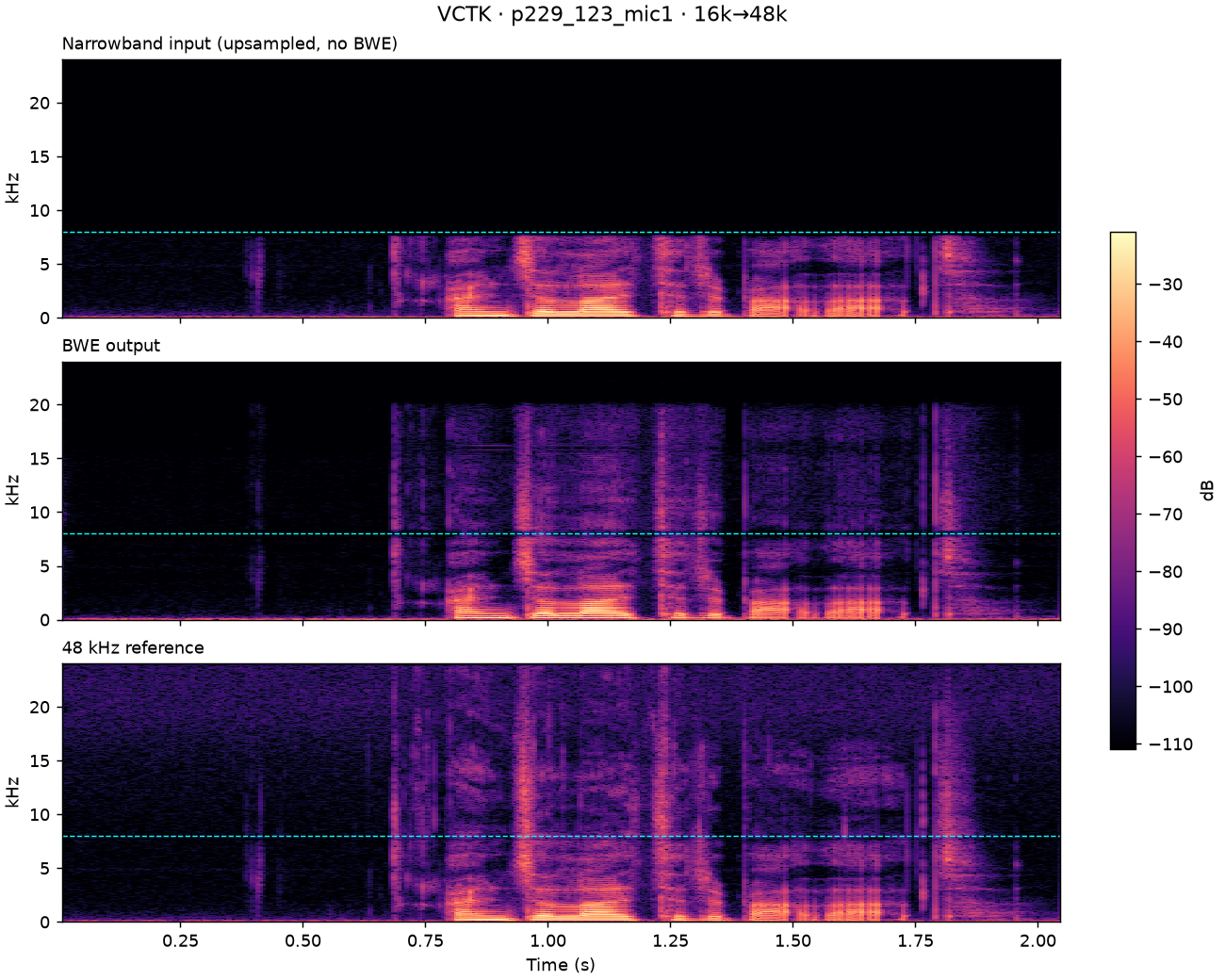
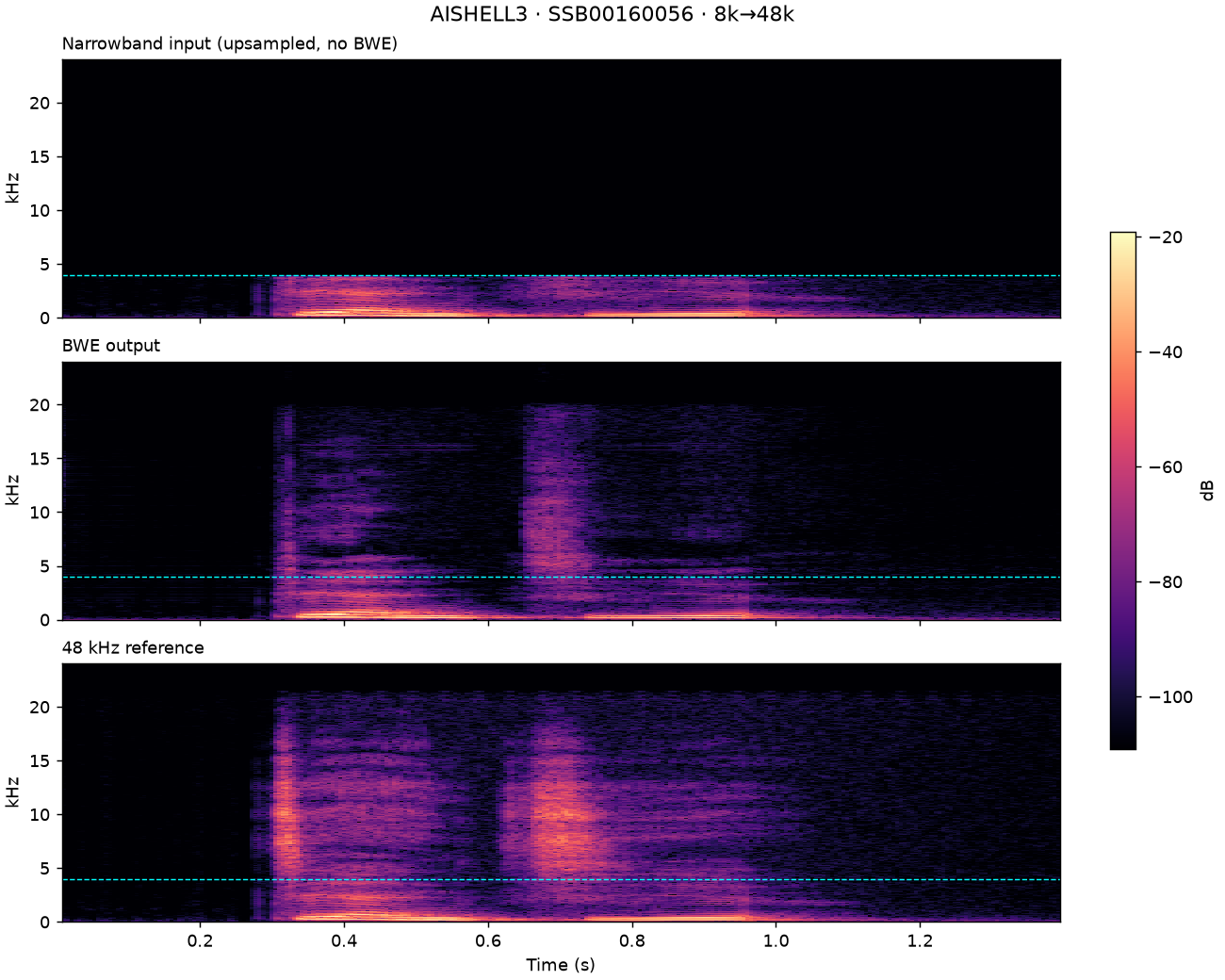
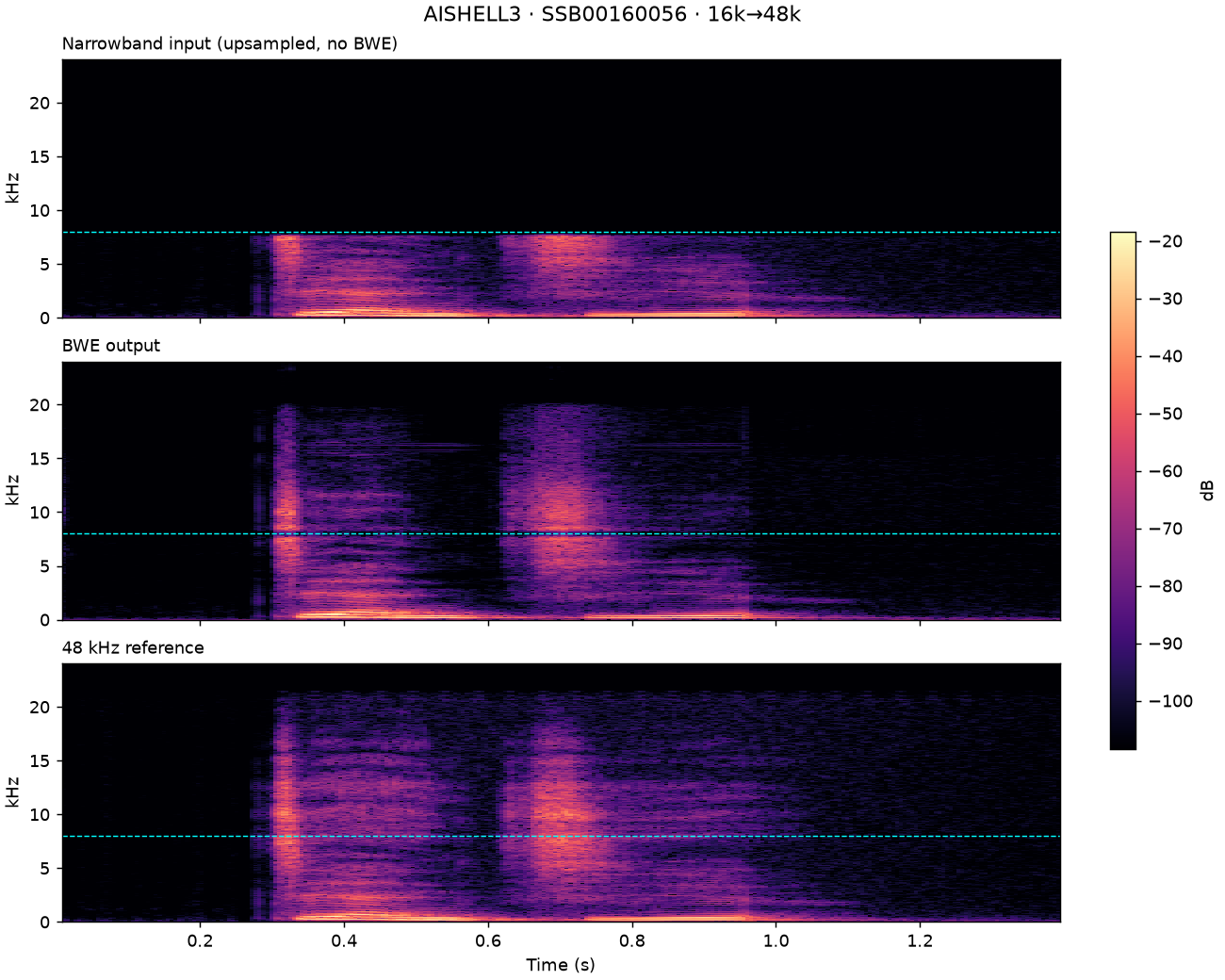
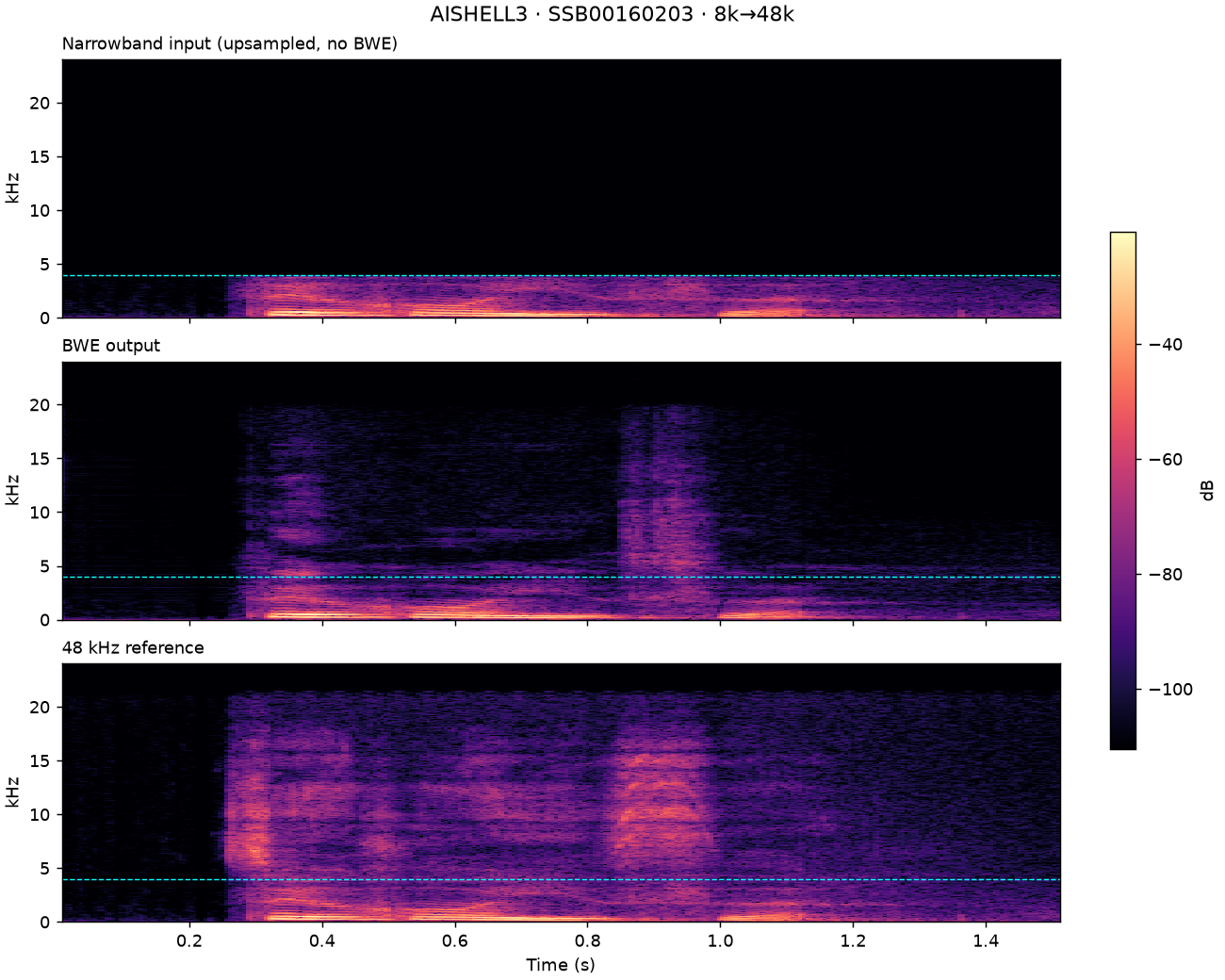
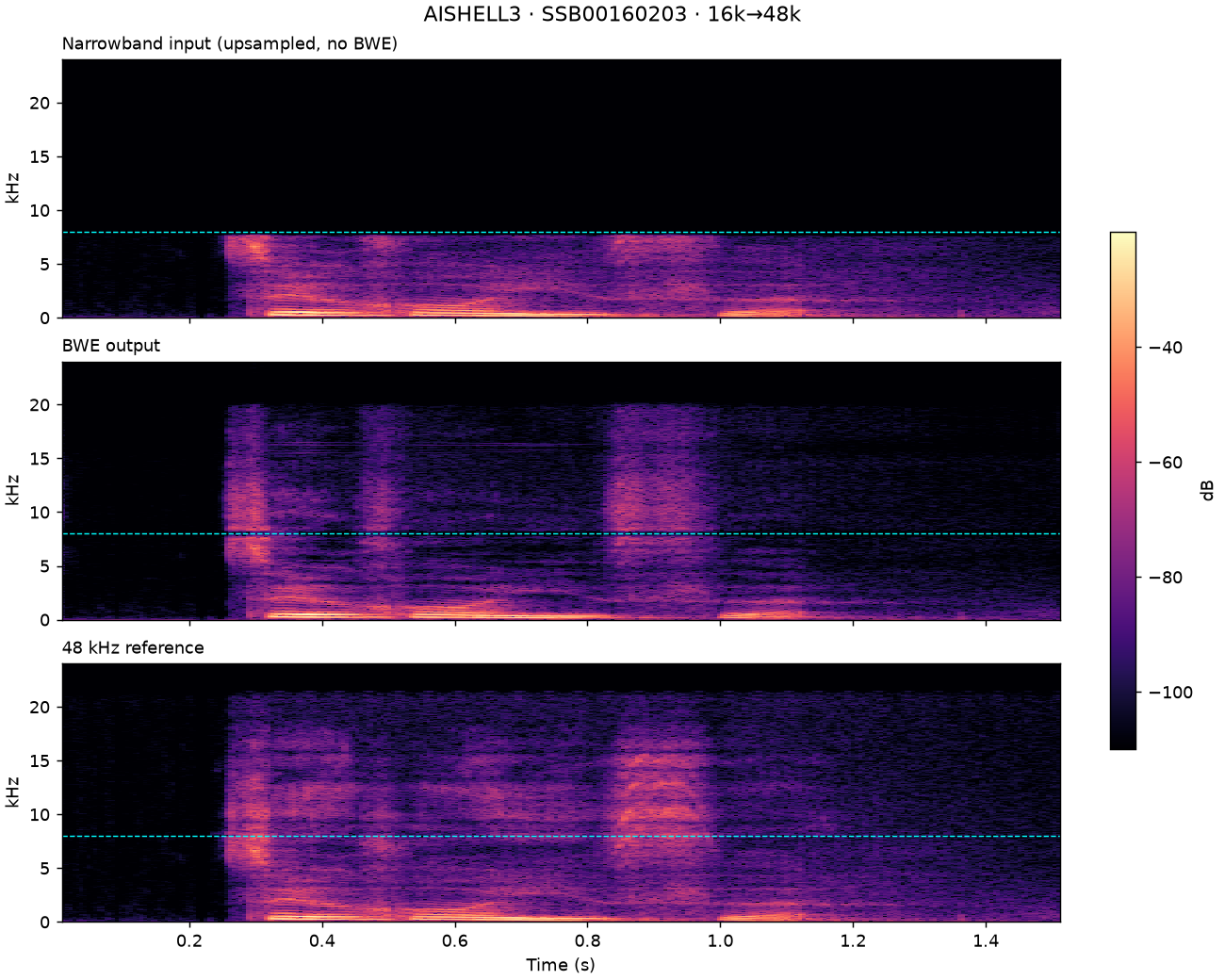
Narrowband speech (8 kHz / 16 kHz) reconstructed to 48 kHz by the SDK. Each block pairs the
spectrograms from the objective evaluation with the exact audio behind them. Use headphones;
the difference lives above 4 kHz.
Objective evaluation
VCTK (English, 30 speakers × 10 utterances) and AISHELL-3 (Mandarin, 30 speakers × 10
utterances), scored against the 48 kHz originals. no BWE is the narrowband input simply
upsampled back to 48 kHz. Mean ± std over files; ↓ lower is better, ↑ higher is better.
Corpus
Mode
System
N
LSD ↓
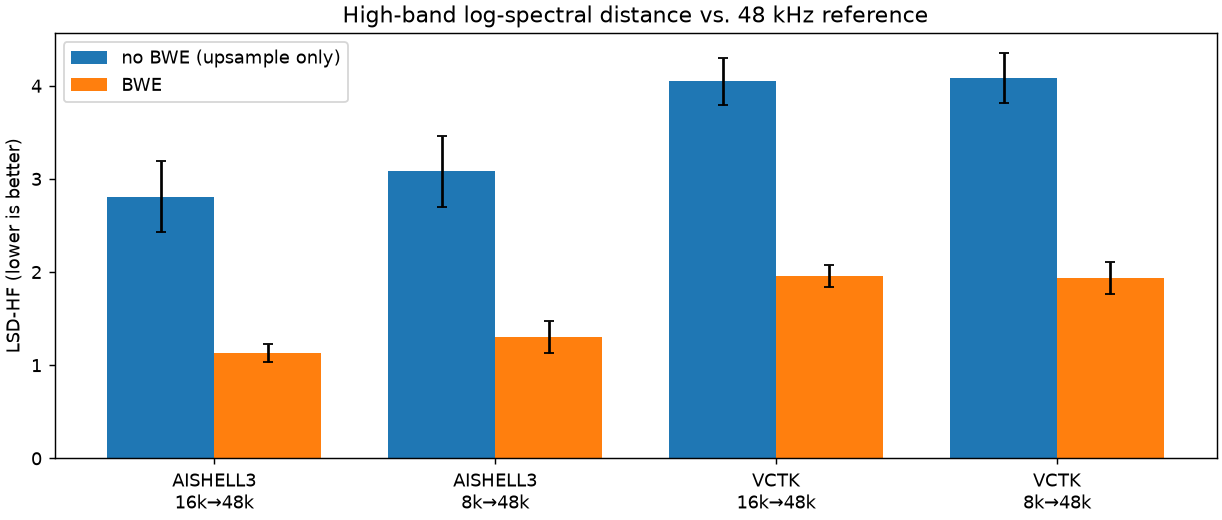
LSD-HF ↓
LSD-LF ↓
SNR (dB) ↑
VCTK
8k→48k
no BWE
300
3.740 ± 0.241
4.083 ± 0.264
0.769 ± 0.054
19.10 ± 4.72
BWE
300
1.801 ± 0.156
1.940 ± 0.172
0.753 ± 0.054
14.38 ± 2.42
VCTK
16k→48k
no BWE
300
3.333 ± 0.208
4.048 ± 0.254
0.745 ± 0.053
25.10 ± 5.63
BWE
300
1.668 ± 0.094
1.956 ± 0.115
0.806 ± 0.054
15.98 ± 2.14
AISHELL-3
8k→48k
no BWE
297
2.831 ± 0.345
3.083 ± 0.381
0.731 ± 0.062
23.07 ± 6.68
BWE
297
1.234 ± 0.155
1.306 ± 0.171
0.726 ± 0.084
15.65 ± 2.63
AISHELL-3
16k→48k
no BWE
297
2.334 ± 0.306
2.809 ± 0.380
0.732 ± 0.070
29.59 ± 7.70
BWE
297
1.030 ± 0.082
1.129 ± 0.096
0.771 ± 0.089
16.38 ± 2.95
High-band log-spectral distance against the 48 kHz reference — no BWE vs BWE, mean ± std over files.
Evaluation utterances
Same preprocessing as the reported numbers: reference RMS-normalised to −26 dBFS,
band-limited with soxr, processed by the SDK, written as 16-bit PCM.